Protest Analysis in MENAAP#
This notebook analyzes protest events in the Middle East and North Africa (MENA) region using ACLED (Armed Conflict Location & Event Data Project) data. The analysis covers 157 countries globally and 21 countries in MENAAP.
Protest Trends#
In this section, we visualize protest trends across different dimensions:
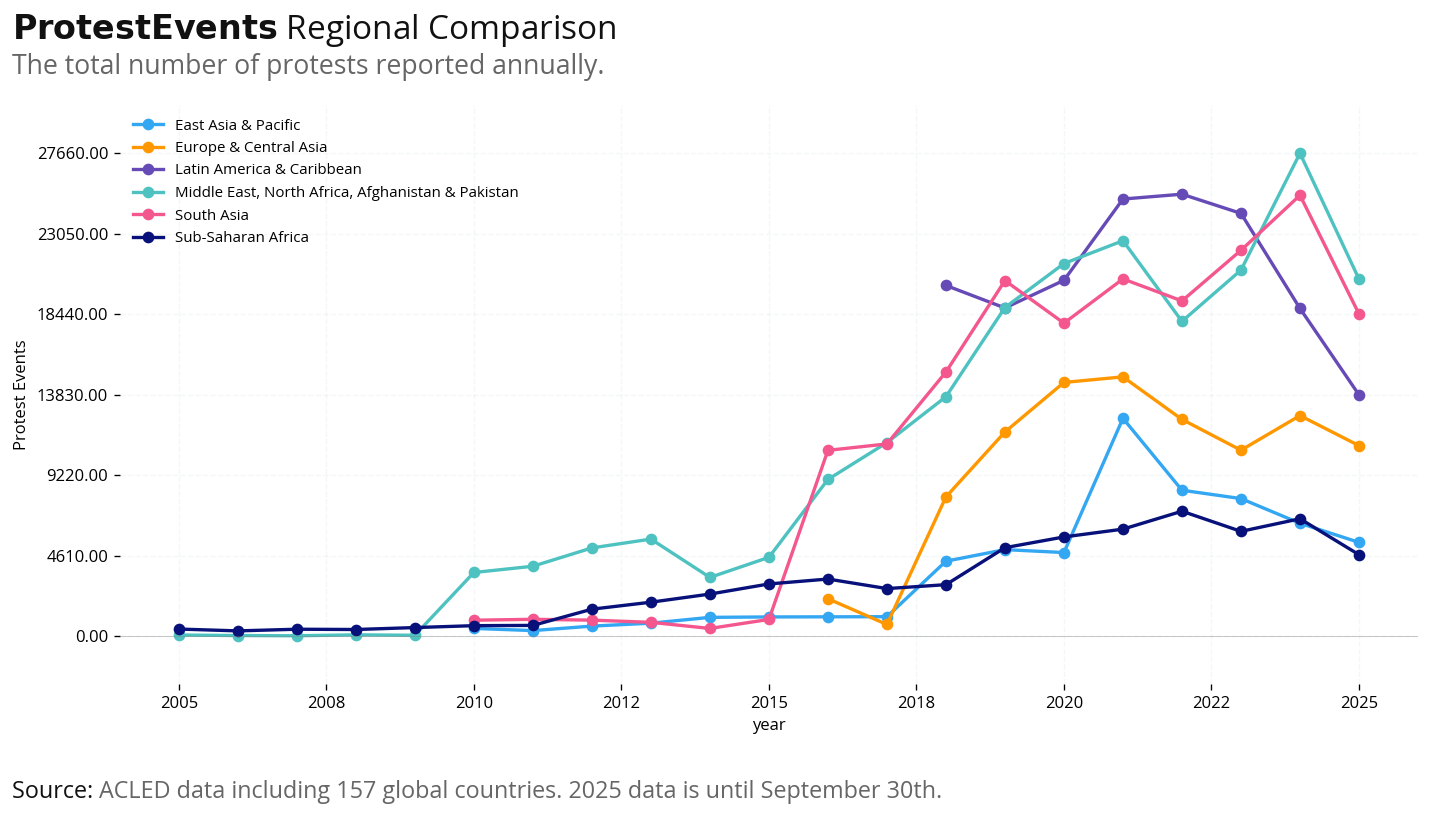
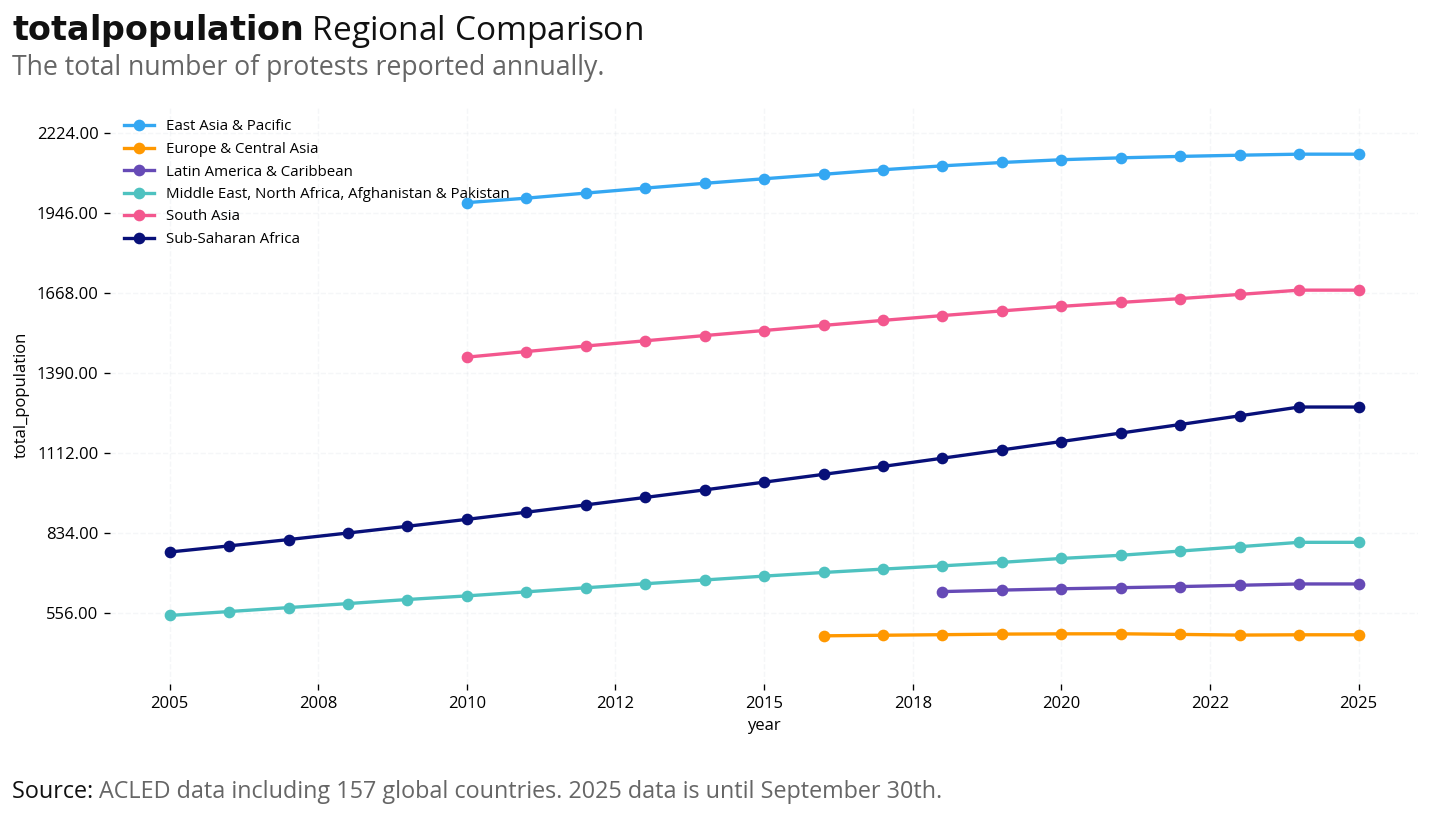
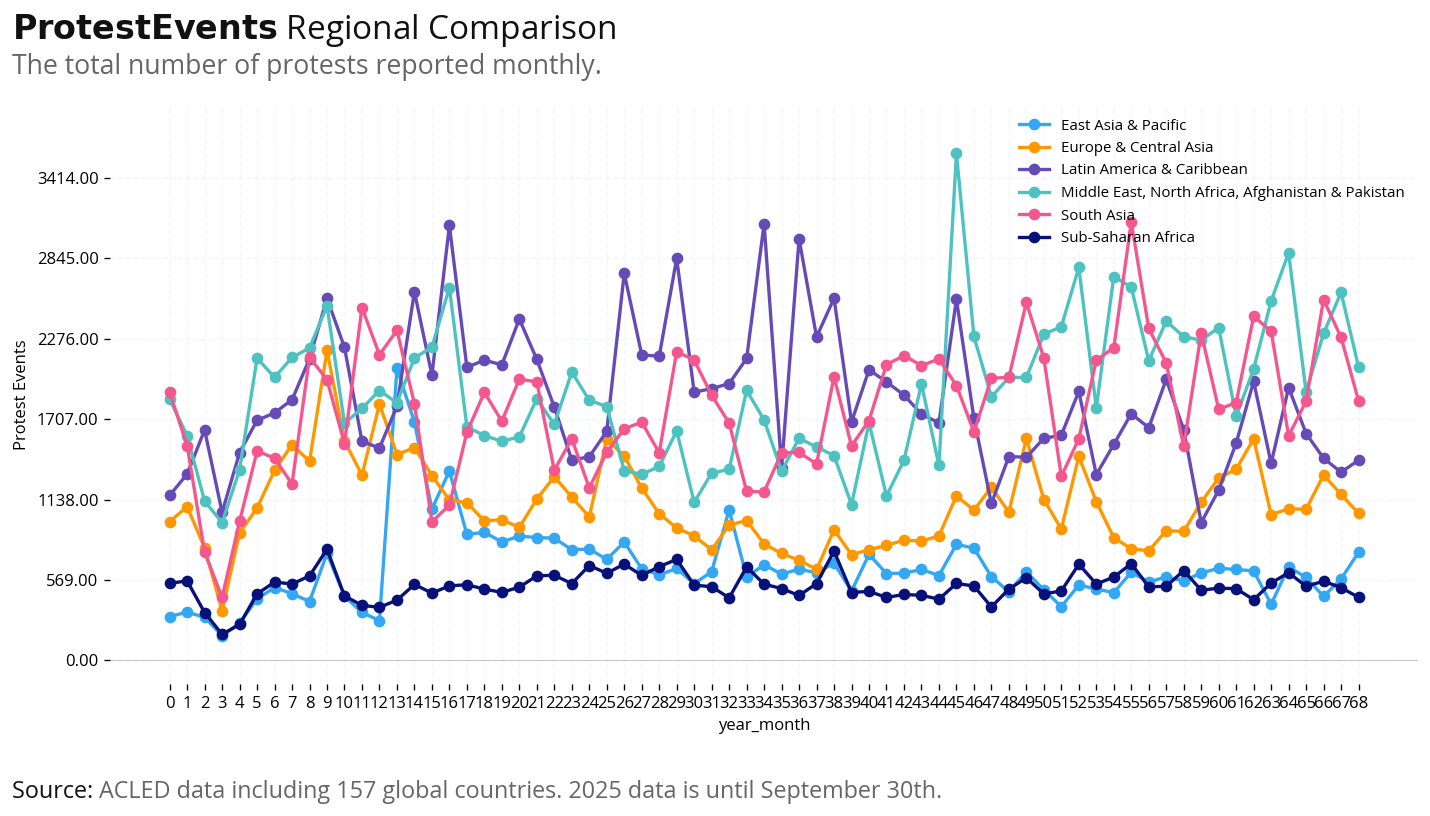
Regional Comparison (Absolute Numbers): Total protest events by year across World Bank regions (MENA, Sub-Saharan Africa, East Asia, etc.) to identify which regions have the highest protest activity.
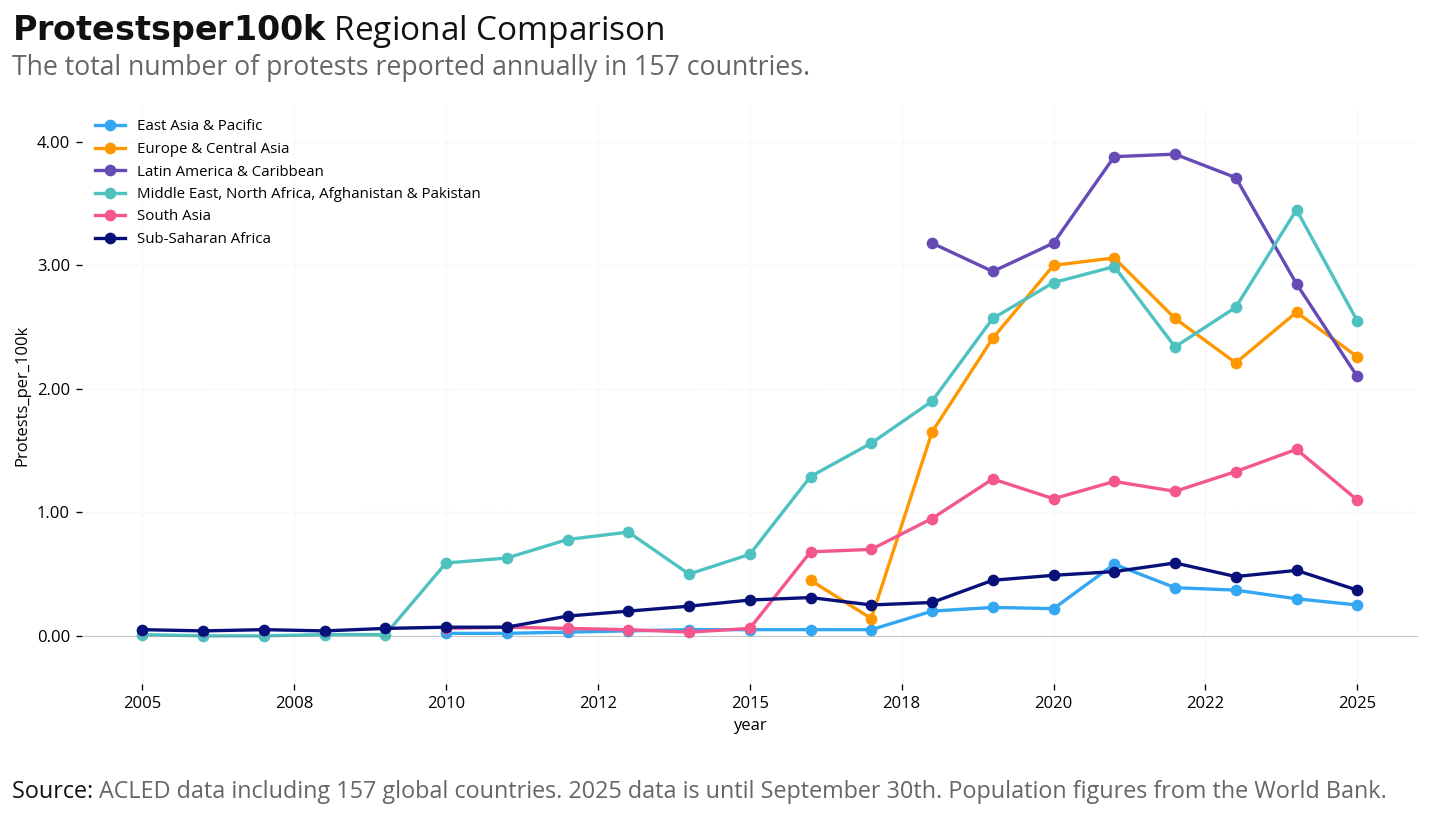
Per Capita Analysis: Protests per 100,000 population to account for different population sizes. This shows which regions have the highest protest intensity relative to their populations.
Protest Topics using Simple Word Cloud#
This section performs text analysis on protest descriptions to understand what protesters are demanding and concerned about:
Custom Stopwords: We define domain-specific stopwords (common words like “protest”, “demonstration”, etc.) that don’t reveal the actual issues protesters care about.
Word Normalization: Group related word forms together (e.g., “moroccan”/”moroccans” → “morocco”) to get accurate counts of key concepts.
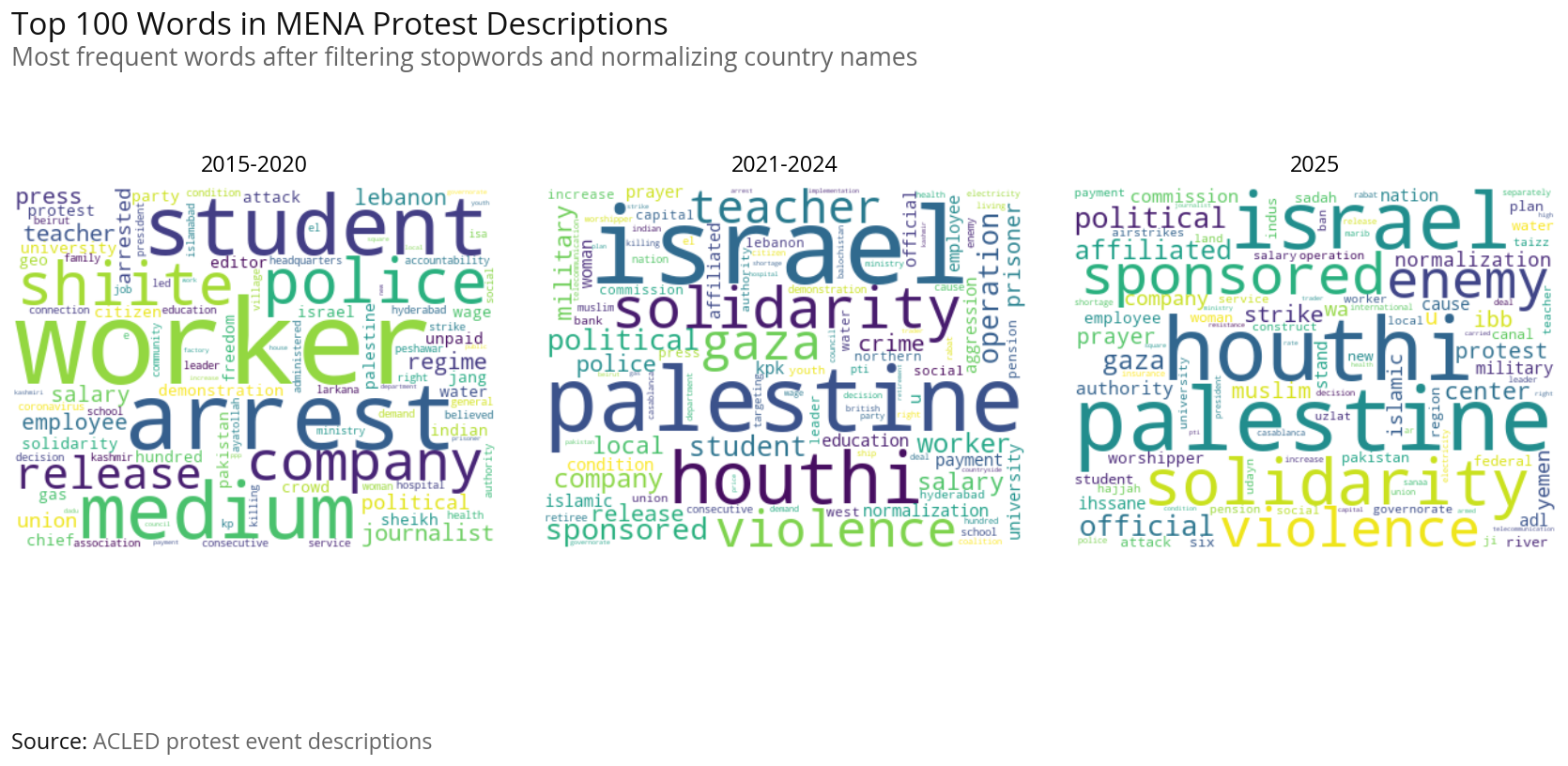
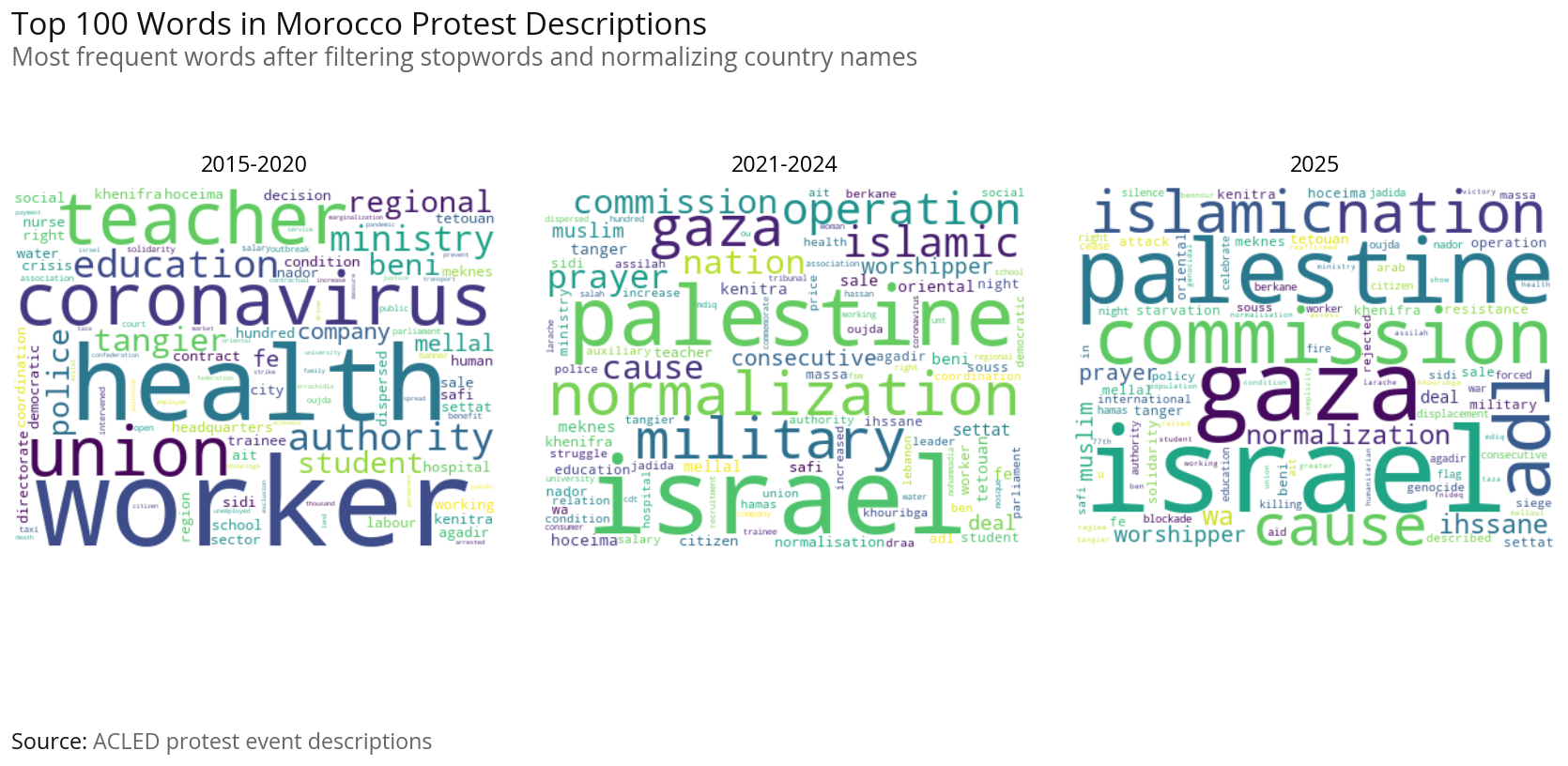
Word Frequency Analysis: Count the most common words after filtering stopwords and normalizing, revealing key themes like “government”, “salary”, “unemployment”, “water”, etc.
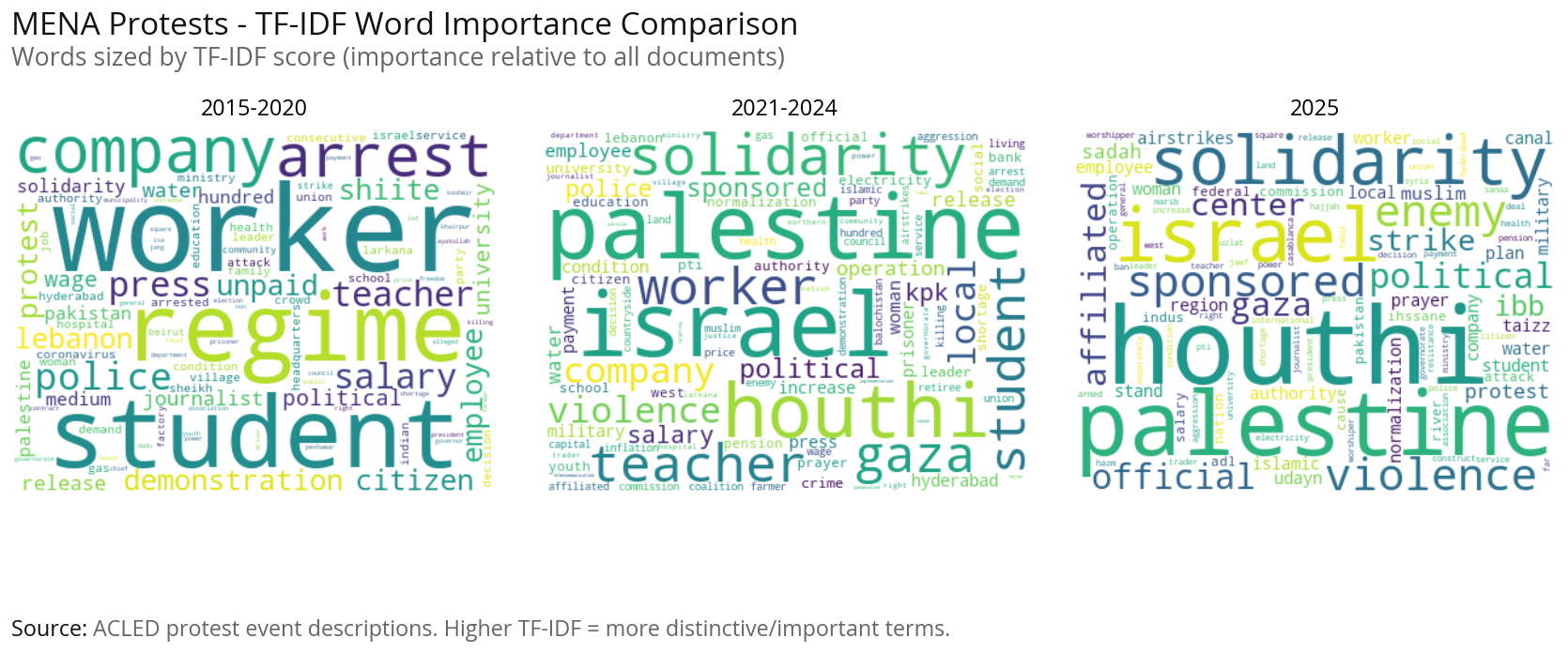
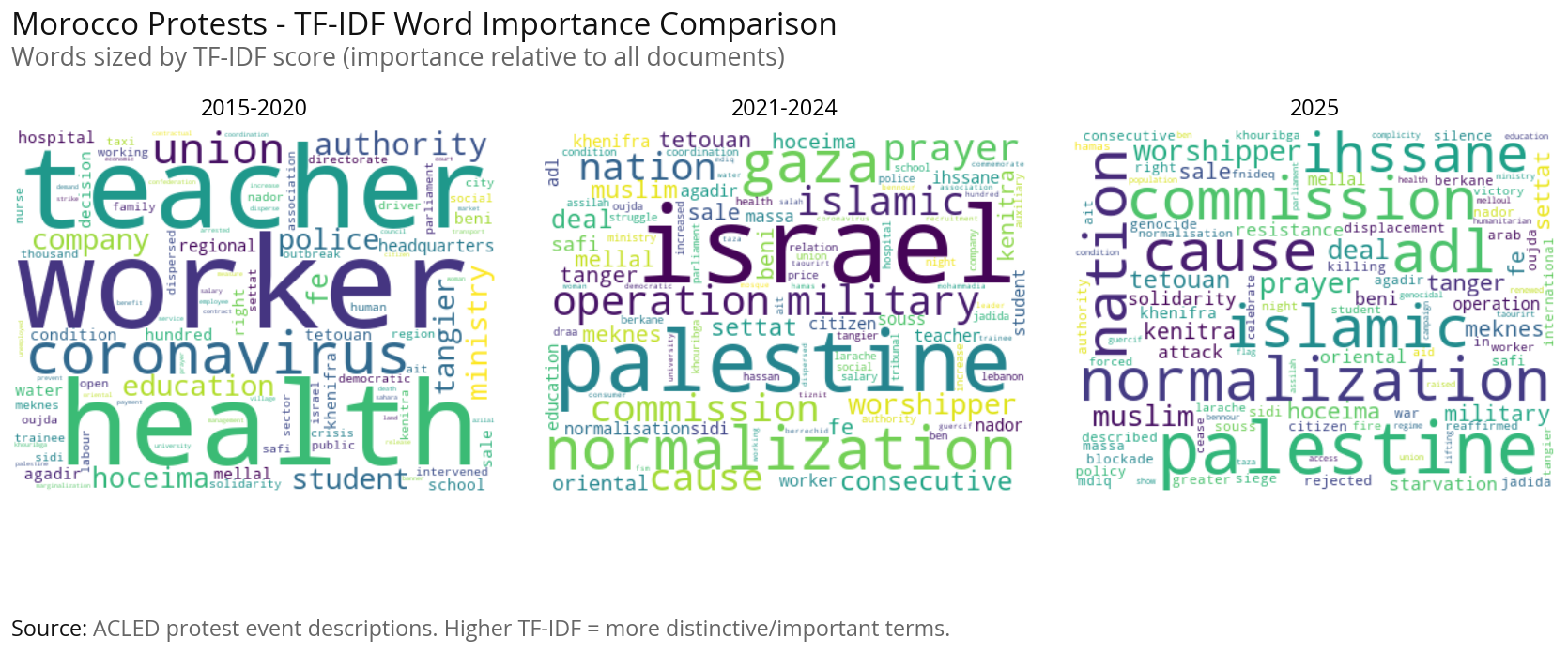
Temporal Comparison: Compare word clouds across three time periods (2015-2020, 2021-2024, 2025) to see how protest themes have evolved.
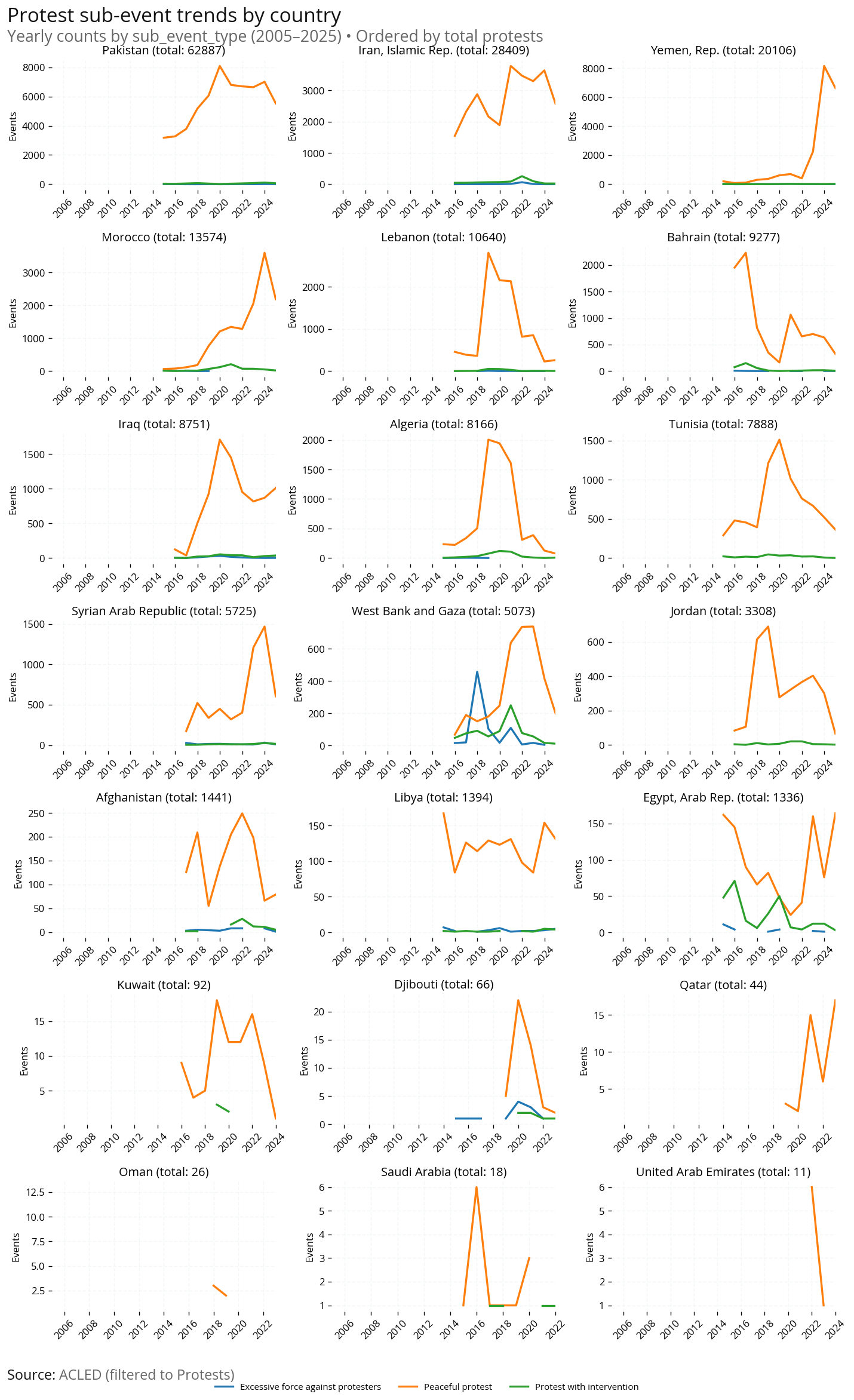
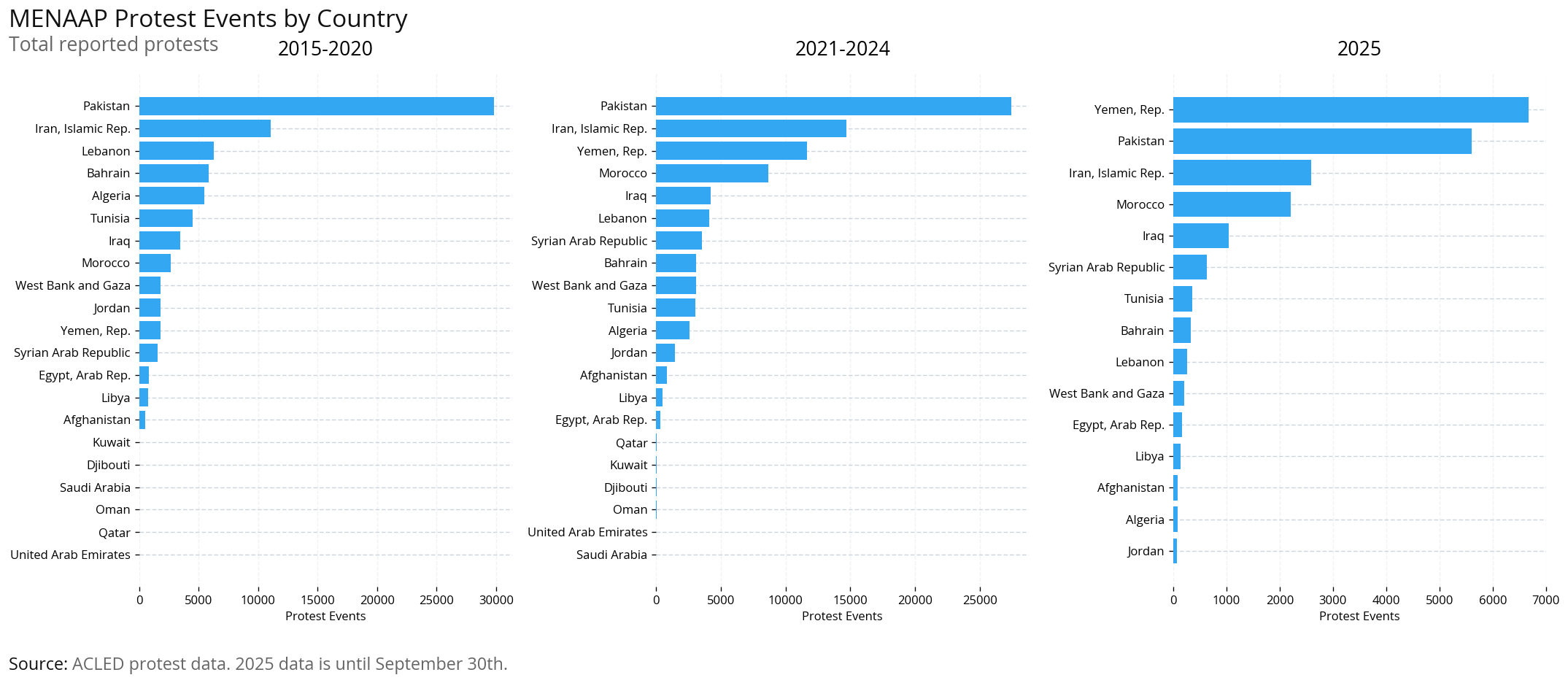
Geographic Analysis: Compare protest event counts by country across the same time periods to identify which countries have the most protest activity.
Debug: Why “dozen” isn’t filtered#
The issue is likely one of these:
Processing Order: We filter stopwords BEFORE lemmatization, but “dozens” → “dozen” during lemmatization happens AFTER filtering
Variant Forms: The text might contain “dozens”, “dozen’s”, or other variants
Case Issues: Though we handle case conversion
Solution: We should lemmatize BEFORE checking stopwords, not after.
def get_word_counts_improved(df, column_name, custom_stopwords):
    """
    Improved word count function with proper processing order:
    1. Tokenize
    2. Clean & lemmatize
    3. Check stopwords (on cleaned forms)
    4. Normalize
    """

    # Word normalization dictionary - same as before
    word_normalizations = {
        'moroccan': 'morocco', 'moroccans': 'morocco',
        'palestinian': 'palestine', 'palestinians': 'palestine',
        'israeli': 'israel', 'israelis': 'israel',
        'egyptian': 'egypt', 'egyptians': 'egypt',
        'iraqi': 'iraq', 'iraqis': 'iraq',
        'syrian': 'syria', 'syrians': 'syria',
        'lebanese': 'lebanon',
        'yemeni': 'yemen', 'yemenis': 'yemen',
        'tunisian': 'tunisia', 'tunisians': 'tunisia',
        'algerian': 'algeria', 'algerians': 'algeria',
        'libyan': 'libya', 'libyans': 'libya',
        'jordanian': 'jordan', 'jordanians': 'jordan',
        'afghan': 'afghanistan', 'afghans': 'afghanistan',
        'pakistani': 'pakistan', 'pakistanis': 'pakistan',
        'saudi': 'saudi arabia', 'saudis': 'saudi arabia',
        'emirati': 'uae', 'emiratis': 'uae',
        'salaries': 'salary',
        'retirees': 'retirement', 'retired': 'retirement',
    }

    text = " ".join(note for note in df[column_name])
    words = re.findall(r'\b\w+\b', text.lower())

    # Prepare stopwords
    wordcloud_stopwords = STOPWORDS
    all_stopwords = wordcloud_stopwords.union(custom_stopwords)
    all_stopwords_lower = {word.lower() for word in all_stopwords}

    processed_words = []

    for word in words:
        # Skip numeric values
        if word.isnumeric():
            continue

        # Lemmatize first (this converts "dozens" → "dozen")
        lemmatized = lemmatizer.lemmatize(word, pos='n')

        # Then check stopwords on the lemmatized form
        if lemmatized.lower() in all_stopwords_lower:
            continue

        # Apply normalizations
        normalized = word_normalizations.get(lemmatized, lemmatized)
        processed_words.append(normalized)

    # Count the occurrences
    word_counts = Counter(processed_words)

    # Create DataFrame
    word_count_df = pd.DataFrame(word_counts.items(), columns=['Word', 'Count'])
    word_count_df = word_count_df.sort_values(by='Count', ascending=False)

    return word_count_df

print("✓ Improved word count function created - lemmatizes BEFORE stopword filtering")
✓ Improved word count function created - lemmatizes BEFORE stopword filtering
# Test the improved function with Morocco data
print("Testing improved word count function...")
print("="*50)

# Test with a small sample to debug
test_mor_wc = get_word_counts_improved(morocco_2015_2020.head(100), 'notes', custom_stopwords + morocco_custom)

print("Top 20 words from improved function:")
print(test_mor_wc.head(20))

# Check if "dozen" appears
if "dozen" in test_mor_wc['Word'].values:
    dozen_count = test_mor_wc[test_mor_wc['Word'] == 'dozen']['Count'].iloc[0]
    print(f"\n❌ 'dozen' still appears with count: {dozen_count}")
else:
    print(f"\n✅ 'dozen' successfully filtered out!")

print("\nComparing with original function:")
test_mor_wc_original = get_word_counts(morocco_2015_2020.head(100), 'notes', custom_stopwords + morocco_custom)
if "dozen" in test_mor_wc_original['Word'].values:
    dozen_count_orig = test_mor_wc_original[test_mor_wc_original['Word'] == 'dozen']['Count'].iloc[0]
    print(f"❌ Original function: 'dozen' appears with count: {dozen_count_orig}")
else:
    print(f"✅ Original function: 'dozen' filtered out!")
Testing improved word count function...
==================================================
Top 20 words from improved function:
               Word  Count
1            jerada     32
2          economic     28
5              died     27
0          thousand     26
8              mine     26
3   marginalisation     26
7              coal     24
6           digging     23
10              men     19
9             young     18
11        abandoned     18
19              rif     14
20           region     12
14           slogan     12
15            hirak     12
18     neighbouring     11
72            force     11
13          adopted     11
17           string     11
16           shaabi     11

✅ 'dozen' successfully filtered out!

Comparing with original function:
✅ Original function: 'dozen' filtered out!
The autoreload extension is already loaded. To reload it, use:
  %reload_ext autoreload
The autoreload extension is already loaded. To reload it, use:
  %reload_ext autoreload
Protest Topics using TF-IDF#
This section uses advanced natural language processing to identify distinct protest topics/themes:
Method: TF-IDF (Term Frequency-Inverse Document Frequency) with K-means clustering identifies groups of protest events that share similar language and themes.
Process:
Text Preprocessing: Apply word normalization and custom stopwords to clean the data
TF-IDF Vectorization: Convert text to numerical features, weighting words by their importance
Interpretation: Each topic represents a distinct protest theme (e.g., economic demands, political reform, sectoral grievances). The country distribution shows whether topics are geographically concentrated (country-specific issues) or widespread (regional concerns).
Time Period Analysis: We run this analysis separately for 2015-2020, 2021-2024, and 2025 to see how protest themes have evolved over time.